

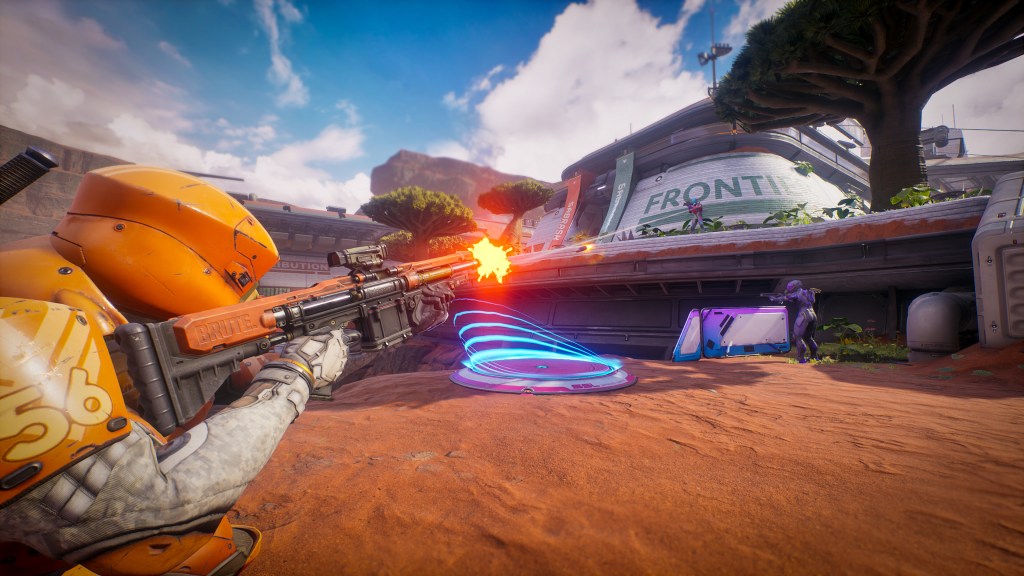
SPLITGATE 2 INTERVIEW W/ IAN PROULX
by Ethan Anderson
As someone who’s much more on the casual side when it comes to FPS games, I’ve come to terms with the fact that I don’t need to be the very best to have fun. With that said, I do need a hook that goes beyond shooting at the other team to get a respectable K/D.
Titanfall 2 is my favorite multiplayer shooter of all time because it scratches that itch with its movement, mechs, and unique feel. Splitgate 2 is similarly grabbing my attention, making me want to learn more about the game before jumping in to try it for myself.
I was fortunate enough to speak with Ian Proulx, CEO and co-founder of 1047 Games, at PAX East this year to ask a few questions about what I can expect to see in Splitgate 2. Here’s what he had to say about the upcoming portal shooter.
Ethan Anderson: I’m kind of casual when it comes to FPS games, who’s enjoyed playing a few like Titanfall, Apex Legends, Halo, etc. How do you think someone like that can get into Splitgate 2? Is that a focus or something you think about?
Ian Proulx: Totally, totally. I mean, my focus is making a game that’s fun. So, I don’t try to prioritize for competitive versus casual. I just want to make a fun game. That’s it. And I think Splitgate 2 really is a lot more accessible this time around without jeopardizing, kind of, the high skill ceiling.
And so there’s a number of things we’ve done. The biggest thing I’d say is just the overall UX of the portals. It’s now one button. You can go back to the old method if you want to use Spitgate 1 controls, but, you know, my philosophy is like, are there ways I can make this easier to learn, but equally difficult to master? And so with Splitgate 2, there’s the one-button portal press that knows which portal you want to spawn.
And so, instead of the skill gap being like, ‘Oh, did I press the right button? I couldn’t remember, I had to learn that.’ It’s like, no, the skill gap is, ‘Did I make the right decision and have the right reaction times to flank you?’ That’s what I want the skill gap to be, not, ‘Oh, wait, I got to remember which button to press.’ That’s not a fun skill gap for good players or bad players. And so for me, I think that’s one thing we’ve done.
But overall, I mean, you know, we tried to design with the mindset of any player should be able to come in, turn their brains off, use zero mechanics whatsoever, and just WASD left click, and that should be a fun experience. You should not be able to dominate by doing that, you should not be the best player in the lobby by doing that. But you should be able to have fun by doing that. And so I think we’ve hit that. I don’t think we had that in Splitgate 1, but I think in Splitgate 2, we have achieved that just with a number of improvements.
Ethan: You talked about improvements made in Splitgate 2. What did you learn from the first game that you wanted to translate into the second game? What can players expect in terms of differences or shifts?
Ian: So, I’ll start with things we’ve improved, and then things we’ve learned. So, I mean, the first thing you’ll notice is just the overall polish, and the level of detail and art style. It’s a triple-A game. It’s the difference between a 15-person studio, which is what Splitgate 1 was, and a 200-person studio, which is what Splitgate 2 is.
And we’ve just hired a lot of industry veterans. We hired the animation director from Call of Duty. We hired the audio director for Halo. Like, these are two of the best people in the entire industry, and they’ve really helped level up the game. But really, the whole team is super talented. So that’s the first thing you’ll notice.
That wasn’t necessarily a learning; that was just more firepower, right? The learnings, I would say, a lot of it came down to just the importance of live service, right? And so, thinking through that, Splitgate 1, we never thought about what’s post-launch. We just made a game. It was, ‘Let’s combine my two favorite games, Halo and Portal. That sounds really cool.’ And it was, and it’s awesome, and I was really proud of it. But Splitgate 2, we’ve really thought through, like, how do we operate this thing in a way that will last for years to come?
And so, thinking through the post-launch content, thinking through the code base, how you structure it. Just thinking through the classes and the loadouts so that there’s more to do, more to learn, more to unlock, more to, you know, progress. Really thinking through all of that stuff, so that players have something to play and it’s always fresh.
Ethan: Do you have a favorite new feature that you implemented in Splitgate 2 that wasn’t in Splitgate 1?
Ian: I would say the slide. You know, that’s the thing I always felt was missing for Splitgate. I think, as an FPS fan in general, I love Halo, I love Titanfall, love Call of Duty – especially the older ones. And I felt like we nailed the gunplay, and obviously the portal mechanic. To me, though, the most important things about this game, by far, are: the gunplay’s got to be amazing. The movement’s gotta be amazing, and the portal’s got to be amazing. It’s those three things.
I think, in Splitgate 1, we nailed two of them. I don’t think we nailed the movement. I think it worked, but I don’t think it was like this masterpiece of movement. And I think in Splitgate 2, that’s the thing I’m really proud of, is just, I really think we nailed that movement. The jetpack feels like a Black Ops 3 jetpack. The sliding feels like Titanfall 2. Chaining all of that together with the portal mechanic, I mean, it all goes so hand in hand.
And you even notice that the way the maps are designed, you know, everything is intentional, right? So you’ll see, on a map like Zenith, you’ll have these small slopes. They’re not just there to be a roadblock. They’re there, so you can chain a portal momentum jump into a slide, into a flank, right, and just chain it all together. Or you look at Glacier, the large-scale biome. You know, there’s lots of jump pads mixed with portal jumps mixed with sliding. So, it all kind of goes hand in hand, and I think it all works. And that was a missing piece.
Ethan: I love movement like that in FPS games because it’s always fun –
Ian: And Titanfall 2, actually, was a huge inspiration for the movement. I think people look at Splitgate 1 as Halo meets Portal, which I take as a compliment. Splitgate 2, though, I did want to iterate on the movement. So, the gunplay is very Halo inspired, but the movement – and especially the slide – are very Titanfall inspired.
Ethan: What would you say was the most difficult feature to implement in Splitgate 2?
Ian: That’s a good question. Okay, so I’ll say the most difficult [feature] wasn’t actually any particular thing to implement. Actually, I’ll get to that, too. The most difficult thing has just been scaling a team and maintaining the passionate, kind of, community-first focus that we have.
You know, we’ve scaled from 15 people to 200 in three years. That’s not easy to do. It’s very easy to lose your identity along the way. It’s very easy to make mistakes. I’m really proud of the team more than anything because I think it feels like the exact same team. It feels like the same community-focused, passionate group of talented people. There’s just more of us. That’s what I’m most proud of. And that’s what was most difficult to do.
I think, in terms of technically, honestly, the most difficult thing has been getting us to run at 60 FPS on last gen. There’s a reason most games don’t do it, and a lot of people in the company were like, ‘Why are we doing this?’ And I’ll say, there’s three reasons that we chose to do last gen.
One of them is, there are still a lot of players on last gen. It’s like 30%. So, it’s not nothing. But there’s two other reasons that aren’t just about increasing the player base slightly. It’s, if we can run at 60 FPS on a PS4 or an Xbox One, we can run at 60 FPS on a potato PC. And it also means we can run at 300 FPS on a really good PC. Optimization and gameplay are the most important things to me, and so, that sort of forced our team to really focus on that from day one, instead of just making it an afterthought.
And then, the third thing is, you know, playing with your friends is super important, right? And if you think 30% of the players are on last gen, that means your friend group – your party of four – and our game is teams of four, right? If one of your four friends can’t play, you’re gonna go back to the game where all four of you can play. And so we don’t want to break up the party or break up the friend group. We want to make sure that whatever platform you’re on, you can still play.
And, you know, Switch 2. Obviously, I’d love to do that in the future. We have not even started on it. You know, if you know anybody at Nintendo, please connect me! But it’s going to be a lot easier to get to Switch 2 someday if we’re already on PS4 and Xbox One.
Ethan: So, what kind of release date were you looking at for Splitgate 2?
Ian: Well, so the open beta goes live May 22nd, and that’ll be on all of those platforms. And of course, Steam, Epic Games Store, and Windows Store. In terms of launch, it’s coming in hot. It’s going to be pretty soon. We haven’t announced an exact release date, but what we have said is, once the beta is live, we’re not turning it off. It’s not like a week-long beta. It is, here’s the game. Go enjoy, and launch will come soon.
*EDITOR’S NOTE*
This interview was conducted before The Hat Incident. Also, Splitgate 2 would surprise launch just three weeks after the beta on June 6th. If you’d like to know Jarrett’s thoughts on the final product, check out his review at IGN.com
 LIFEBAR MAGAZINE