

PRAISE THE MEAT
by Andrei Filote
A worm crawled up my arm and rested on my neck. It whispered:
For better or worse, meat is what we are. We flap our meat at each other to speak, meat pumps blood through our bodies, our minds are meat electrified. Oh, yes, lightning courses in us. One fine day, we put that lightning into cleverly sculpted minerals and enabled a digital reproduction that only recently has begun to subvert us.
In System Shock 2 a wholly digital being invents its own meat, and the meat begins to subvert it instead. To arrest that process, the original chaos machine is called up: a human being. You, a schmoozer with a beer belly and an rpg progression curve, is actually the most dangerous thing in the cosmos. Well, so long as we offload our thinking to SHODAN, a genocidal AI who needs us to exterminate its own genocidal creation. What was the line? A man chooses, a slave obeys?
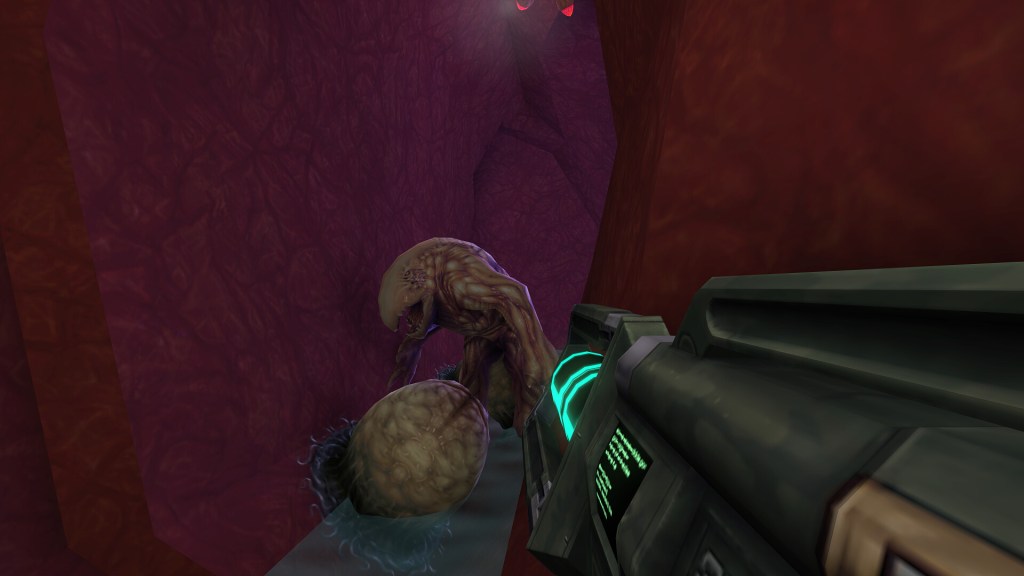
Our second actor is the meat. The Many, a hivemind that inhabits a dual state of bliss, in its consent-agnostic unity, and revulsion, for man’s disunity. The Many is able to absorb people into its biomass with the lure of its telepathy. The voices of those it brainwashes are some of the best writing in Shock 2, as they relate the reassurance and eventually the rapture of no longer having to think for themselves.
We also meet Xerxes, a boring butler of a ship computer whose capture by the Many spells catastrophe for the human resistance. The word meet isn’t correct, of course. In the mind, a meeting is an animal registering an encounter with another animal. Xerxes is closer to Windows 11, software that was designed to be useful but that now needs to be deleted before it inflicts more damage. We are inflicted with Xerxes, and taking it down makes up a precondition of our victory.
Like so much scifi, a single idea underpins the danger of AI. However much we want a digital servant to save us from our own limitations, there is no substitute for hard work. There’s a bit of comedy in watching a triad of dependency formed by the very things that are supposed to be so much better than humanity. SHODAN creates the Many, the Many corrupts Xerxes, Xerxes seeks protection from, well, the original end user, who, as an honorable mention, takes orders from SHODAN.
Look at this setup with the eyes of 2025 and what do you see? A panacea for intellectual laziness. And then another one. And another. And they’re all fighting each other.
Tech has always been with us. We used it, for instance, to substitute the hard work of strangling a man, with a bow and arrow. But we couldn’t substitute the hard work of aiming the weapon, until much recently, when we created missiles that can kill a man, and that man alone, in his own home, and bombs so large they don’t need to be aimed at all. And even those can’t exist without the mounting hard work of experts and industries, and that leads down a trail of innovations that brings us back to man sharpening a rock.
But as of yet, it is not possible to replace our thinking, not in any industry building way. And the industry of thinking is what? Education, Hollywood, countless R&D departments, your local museum of horror cinema. (What did Google Search give us over thirty years? The ability to put “SEO expert” on our resumes?) When a clown on the street pulls a funny face, they are doing something so complex that its image trained replication may only come across as the surface imitation of a pathetically limited toy managed by minds too small to understand the smallness of the machine that they built.
The AI building myth that blooded, breathing storytellers dreamed up stands contrary. The technology will become something too great for us to understand, and having exceeded all metaphors, we will have spawned our own gods. Isaac Asimov reimagined the biblical story of creation. Mass Effect represented our complex relationship to technology through the Reapers. Neither Asimov nor Bioware were right. SHODAN was. Here is her criticism of humanity: “You move like an insect. You think like an insect. You are an insect.” It is a chain of self-evident reasoning that explains our acceptance of ChatGPT and our vulnerability to propaganda.
Of all the ways AI has killed us in fiction, the reality is the meanest and stupidest. And it’s far from an apocalypse of organic batteries. Rather, if Skynet were real, it would try to kill us by the inch-length increments of our stupidity, because it itself would be too stupid to be entrusted with anything of real importance.
When we invented the printing press, we changed the world because we gave power and reach to the human mind that it had never known before. A machine that this writer has powered with a sandwich and a coffee, to produce this text, and which has birthed every beautiful thing you have ever treasured. Moby Dick is a creation of the human mind. So is Linux. SHODAN would be astounded to contemplate this. And maybe the humans of the future will be, too.
 LIFEBAR MAGAZINE